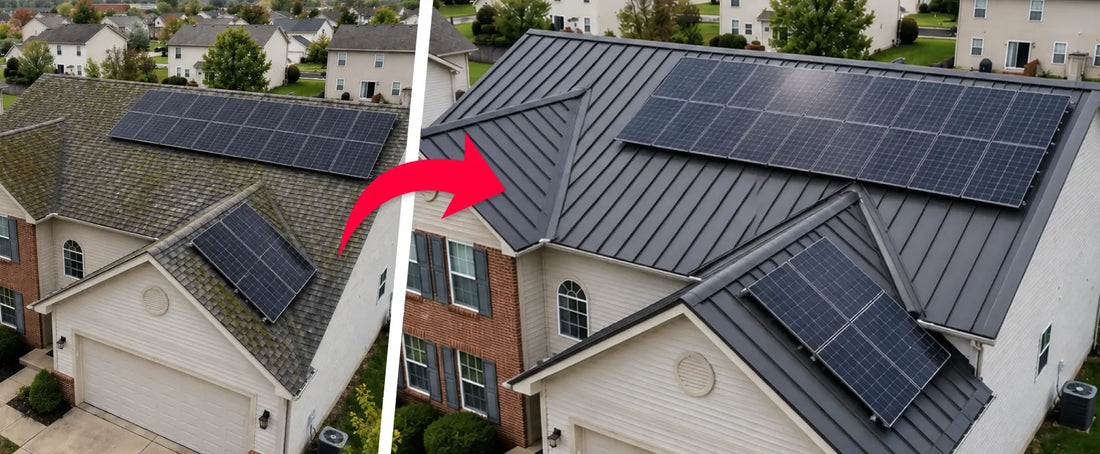
Metal roofing is taking a growing share of American roof replacements, and homeowners keep asking whether the cost is worth it. That depends on your climate, how long you stay, and the condition of the deck underneath.
This guide covers the pros and cons of metal roofing, backed by verified performance data. Understanding the material itself makes the comparison straightforward.
What is a Metal Roof? And What is it Made of?
A metal roof is made of steel, aluminum, zinc, copper, or coated alloys, shaped into panels or shingles, and fastened over a solid deck with underlayment beneath. Homeowners researching tin roofs’ pros and cons are picturing the tin-plated iron on nineteenth-century farmhouses. Systems today are almost entirely steel or aluminum.
Standing seam uses interlocking panels with hidden fasteners. Ribbed and corrugated panels are more affordable but use exposed screws.
Material and profile affect nearly every point mentioned below.
The Pros of Metal Roofs
Any comparison of the pros and cons of metal roofing relies on standardized testing, though they vary with material grade and installation quality.
- Long lifespan: Metal roofs last 40 to 70 years, while three-tab asphalt roofs last 15 to 20 years, so shingles get replaced twice during a metal roof's lifespan.
Wondering whether metal roofing is worth the higher upfront cost over time? Check out this Reddit discussion from r/Roofing, where users discuss the long-term value, durability, maintenance, and overall cost of metal roofing: Is metal roofing really worth the extra cost in the long run? (r/Roofing)
- Low maintenance: Factory coatings resist cracking, chalking, and fading. Yearly fastener checks and debris clearing are enough for upkeep.
- Durability: Metal is less likely to crack, warp, or rot. Panels carry a Class 4 impact rating and withstand two-inch hail.
- Weather resistance: Tested assemblies withstand winds up to 140 mph, and smooth panels shed snow rather than retain it, reducing ice-dam loads.
- Sustainability: Metal roofing can contain 25% to 95% recycled material. In comparison, roughly 12 billion square feet of old asphalt roofing still end up in landfills each year.
- Energy efficiency: Reflective coatings cut cooling costs by 10 to 25 percent, rated on solar reflectance and thermal emittance.
- Fire resistance and safety: Steel and aluminum are non-combustible. Most systems earn Class A by assembly, so the fire-rated underlayment completes the rating.
- Curb appeal: Finishes retain color under UV exposure, and the surface sustains less damage, so appearance declines more slowly than asphalt.
- Aesthetic flexibility: Profiles run from standing seam to ribbed, corrugated, tile-look, and shake-look shingles in twenty-plus UV-stable shades.
- Higher property value: The 2025 Cost vs. Value Report estimates that a metal roof replacement adds about $25,972 in resale value, recovering roughly 50% of its installation cost.
Now let’s move on to the disadvantages of metal roofs.
The Cons of Metal Roofs
None of these drawbacks rule out metal; each changes what you pay or who you hire.
- Higher initial cost: A 2,000-square-foot metal roof averages about $57,700, with costs ranging from $25,700 to $89,600. Steel runs roughly $32,200–$45,300, while copper can exceed $82,000.
Wondering whether a metal roof is significantly more expensive than an asphalt shingle roof? Check out this Reddit discussion from r/Roofing, where users compare the costs of metal and asphalt roofing and share their real-world experiences: Is a metal roof really massively more expensive than an asphalt shingle roof? (r/Roofing)
- Denting and surface damage: Aluminum and copper are susceptible to hail damage, while steel resists it. In terms of steel roof pros and cons, gauge matters more than the metal.
- Potential for rust: Unprotected steel can rust around cut edges and fasteners. Protective zinc or aluminum-zinc coatings reduce this risk, especially in wet or coastal climates.
- Noise during storms: Rain and hail can sound louder on metal roofs. Proper underlayment and insulation help bring the noise level near shingles.
- Expansion and contraction: Exposed fasteners can loosen over time as temperatures change. Proper installation with standing seam clips helps mitigate this issue.
- Color matching for repairs: Paint finishes fade slightly over decades, so a panel replaced years later rarely matches the existing panels.
- Installation complexity: Specialized contractors are needed for proper sealing, flashing, and fastener placement. Poor installation, especially around roof penetrations, can cause leaks.
With both sides listed, the cost question becomes an arithmetic one.
Is Metal Roofing Worth the Investment?
The pros and cons of metal roofing are better judged by long-term value, not just upfront cost. An $18,000 metal roof lasting 50 years may cost less over time than a $9,000 asphalt roof.
Metal may offer less value if you plan to sell soon or the roof deck needs major repairs. For U.S. homeowners, its lifespan, low maintenance, and energy efficiency can help justify the premium price. Lastly, standing seam roofs can also support clamp-on solar mounting without drilling penetrations.
How long you plan to own the home should guide the final decision.
Conclusion
Reading the pros and cons of metal roofing well means matching material to climate and timeline. Its higher price can make sense in areas with strong winds, hail, wildfire risk, or heavy snow, especially for long-term homeowners. Elsewhere, asphalt still competes on total cost.
Before choosing metal, confirm the right material for your climate and hire a contractor with proven experience in metal roofing.