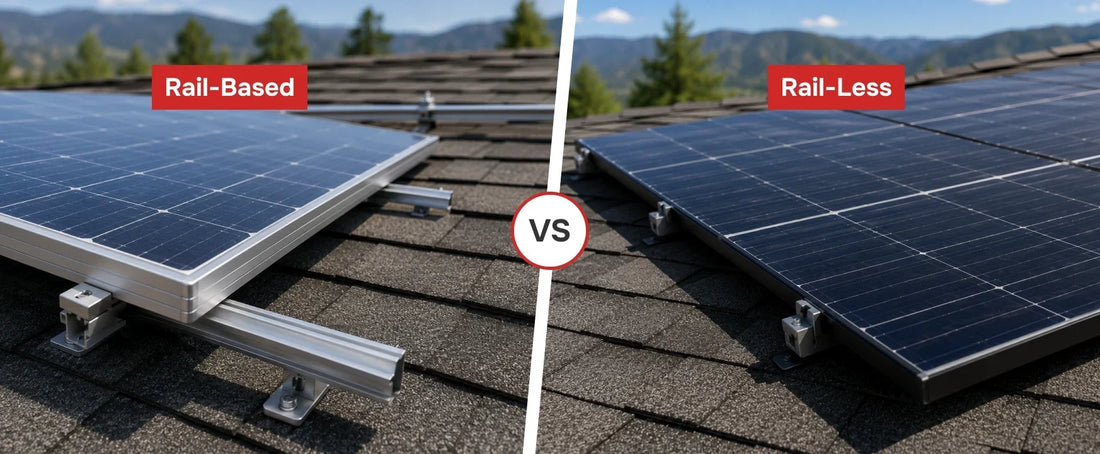
Rail-based and rail-less solar racking systems differ in weight, installation method, wind resistance, and roof impact. Choosing the right one depends on your roof structure, climate, and project scale. Learning the differences between rail-based vs rail-less solar racking is crucial when you’re planning a PV system installation.
Both systems are widely adopted across the U.S. for residential and commercial use. Your roof’s load capacity, installation duration, overall expenditure, and endurance against severe weather are all determined by the type of mounting/racking system you choose. Here’s a detailed comparison to help determine which system best fits your project.
Rail-Based vs Rail-Less Solar Racking at a Glance
| Feature | Rail-Based Racking | Rail-Less Racking |
|---|---|---|
| Structure | Continuous aluminum/steel rails | Direct-attach brackets per panel |
| Wind Load Capacity | High - Weight distributed across the full rail length | Moderate - Each bracket handles each panel independently |
| Weight on Roof | Heavier | Significantly lighter |
| Installation Time | More setup time, faster panel placement | Faster for small-to-mid-size arrays |
| Roof Penetrations | Fewer, evenly spaced | More, but strategically positioned |
| Material Cost | Higher | Lower |
| Aesthetics | Visible, bulkier hardware | Sleek, low-profile finish |
| Panel Orientation Flexibility | Orientation limited to the entire rail run | Landscape or portrait as per individual panel |
| Best For | Large commercial, high-wind zones | Residential, weight-sensitive structures |
| Installer Learning Curve | Low for experienced crews | Moderate for those new to the system |
Now that we've covered the basics, let's dive deeper into each aspect and compare rail-based and rail-less solar mounting/racking systems.
In-Depth Comparison Between Rail-Based vs Rail-Less Solar Mounting / Racking
The differences go beyond hardware design; it's about how each system handles structural stress, dead load, installation complexity, and long-term performance under real-world conditions. Let’s discuss in detail:
I. Structural Load Distribution
Rail-based solar mounting/racking: This approach features elongated metal structures that absorb uplift wind forces as they pass through them. This approach distributes the entire load rather than focusing it on individual fasteners, increasing its adoption in coastal or hurricane-prone areas of the U.S.
Rail-less solar racking systems: This is a different approach where individual brackets resist uplift wind forces as independent sections that hold the panels. With precise engineering, the system can perform reliably. However, their smaller margin for error and greater vulnerability to extreme wind conditions highlight differences from rail-based mounting.
II. Roof Penetrations
Rail-based mounting/racking systems: They require fewer attachment points because a single set of feet supports an entire run of rail.
Rail-less mounting systems: They require more penetrations to secure each bracket, supporting each panel individually.
That said, the brackets and panels in a rail-less mount are designed with proper flashing and sealing to minimize the risk of water intrusion.
III. Weight and Structural Impact
Rail-Based Mounting / Racking System: A continuous metal rail runs across the entire array of solar panels, increasing the dead load on the structure.
Rail-Less Mounting / Racking System: The decisive winner in this category. Without a continuous metal rail running across the full array of solar panels, a substantial amount of dead load is eliminated. Approximately 85% of the collateral load is reduced compared to traditional rail systems.
For older structures in the U.S. that cannot support excessive weight, rail-less mounts are the practical choice.
IV. Installation Workflow
Rail-Based Mounting / Racking System: For larger commercial projects, the initial rail setup becomes an efficient process rather than an extra step, often making rail-based systems the quicker option overall.
Rail-Less Mounting / Racking System: For smaller residential projects, rail-less systems are often faster to install because each bracket can be mounted independently.
It is also worth noting that rail-less systems can be slightly more challenging to install for professionals who have limited experience with direct-attach systems.
V. Maintenance and Longevity
Rail-Based Mounting / Racking System: With such a long, continuous component, it is easy to spot corrosion, loose wiring, or physical damage in a rail-based system.
Rail-Less Mounting / Racking System: Rail-less systems require individual bracket-by-bracket inspection, which can take longer.
However, both systems are typically made from anodized aluminum or coated steel and are designed to last around 25–30 years.
You Can Also Read:
Explore RoofTech's full solar mounting product lineup to see how both approaches are engineered for U.S. roof conditions.
Choosing Between Rail-Based vs Rail-Less Solar Mounting / Racking
There is no universal answer when it comes to choosing between rail-based and rail-less solar mounting/racking systems. Let’s discuss what influences this decision:
- Roof Structure and Age: A rail-less solar racking system is best suited for homes with aging structures or roofs nearing their load capacity. This approach features less hardware and less weight, engineered for lightweight efficiency.
- Wind Exposure: A continuous metal base can handle wind forces much better than individual rail-less brackets. The rail-based mounting system is specifically engineered for demanding wind conditions.
- Roof Complexity: Rail-based systems perform the best on simple, open-pitched roofs and large commercial fields or spaces. Irregularities, obstacles, or shading on a roof, such as dormers, HVAC units, and skylights, complicate long-rail placement. With greater flexibility in placement and orientation, rail-less systems are a better choice for such situations.
- Project Scale: Large commercial solar arrays benefit from the rail-based system’s uniformity and structural consistency. On the other hand, the rail-less solar mount approach is preferable for smaller residential projects because it saves material and installation time.
- Budget Considerations: Upfront costs are lower with rail-less mounting. However, rail-based systems deliver long-term value by reducing the risk of damage and simplifying maintenance.
- Visual Aesthetics: When comparing rail-based vs. rail-less solar mounting, long rail structures can create a more visible and bulky appearance. In contrast, rail-less systems offer a cleaner, more streamlined look, making the panels appear more integrated with the roofline.
Every solar project has unique requirements, making it important to assess both immediate installation needs and long-term performance goals.
Conclusion
Rail-based vs rail-less solar mounting/racking isn’t a competition; it's an alignment question. Rail-based systems offer high structural strength and wind-load resilience, making them ideal for large commercial installations and severe weather conditions. Rail-less systems reduce roof load and material usage while offering a practical solution for many residential projects.
Ultimately, the right choice depends on your roof structure, local wind environment, project scale, and budget. Choosing a system based on your roof structure, climate, and project requirements can help improve long-term installation reliability.