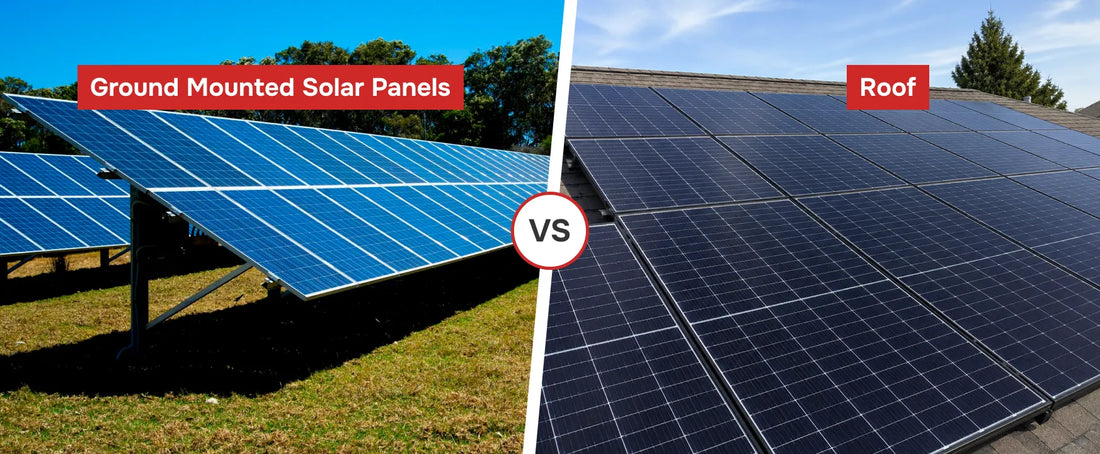
Deciding between ground-mounted solar panels vs roof mounts isn't just a matter of aesthetics. It affects your upfront cost, how much energy you actually generate, and how fast the system returns your investment.
A ground array uses the land around your property, while a roof array is installed on your home or building, and neither option wins by default. The right call depends on your roof condition, your available yard space, and how much power you need.
Here's a straightforward breakdown to help you pick the setup that best fits your property.
Ground Mount vs. Roof Mount Solar: Quick Overview
When weighing ground-mounted solar panels vs roof, this quick side-by-side overview highlights the key differences in one look:
| Factor | Roof-Mounted | Ground-Mounted |
|---|---|---|
| Typical Cost | Lower ($2.75–$3.25/W) | 15–25% higher |
| Space Required | Existing roof area | Open, usable land |
| Tilt & Orientation | Limited by roof design | Optimized for maximum sun exposure |
| Energy Production | May be limited by roof angle, shading, and orientation | Typically higher due to optimal positioning |
| Cooling & Efficiency | Less airflow; can run hotter | Better airflow; operates cooler |
| Maintenance | Requires roof access | Easy ground-level access |
| Permitting | Usually simpler | May require zoning or setback approvals |
| Visual Impact | Integrated with the building | More visible on the property |
| Future Expansion | Limited by available roof area | Easier to expand if land is available |
With the basics on the table, let's dive deeper to analyze the gaps.
Ground-Mounted Solar Panels vs Roof Mounts: What Really Sets Them Apart
Five factors drive almost every decision homeowners face: space, looks, scalability, cost, and performance.
I. Space Requirements
Roof-mounted systems make use of existing overhead space, while ground-mounted systems require open, unshaded land. A typical 10 kW ground-mounted array occupies around 550–650 square feet, depending on panel size and spacing.
II. Aesthetic Considerations
Roof-mounted panels generally blend into the home's design, while ground-mounted arrays are more visible on the property. For some homeowners, especially those in HOA-governed communities, appearance can be an important consideration.
III. System Size and Scalability
Roof-mounted systems are limited by available roof space and layout. Ground-mounted systems can be expanded more easily, making them a practical choice if you plan to add panels later to accommodate an EV charger, heat pump, or increased energy needs.
IV. Performance and Efficiency
Ground-mounted systems can be positioned at the ideal tilt and orientation for maximum sun exposure. Better airflow beneath the panels also helps them operate at lower temperatures. Depending on roof orientation, shading, and local conditions, they may generate 5–20% more energy than a same-sized roof-mounted system.
V. Cost and Maintenance
The cost of ground-mounted solar panels vs roof systems is typically 15–25% higher for ground mounts due to additional racking, foundations, and trenching. However, ground systems are easier to inspect, clean, and maintain, whereas roof-mounted panels may require professional cleaning and additional expense if the roof ever needs replacing.
You Can Also Read:
A Complete Roof Maintenance Checklist for Longer Roof Life
With the key differences covered, the next step is choosing the right fit for your home.
Ground Mount vs Roof Mount Solar: Which One Wins for Your Home?
Ground-mounted solar panels vs roof mounts isn’t a technology debate; it depends on multiple considerations. As the more affordable and permit-friendly option, residential rooftops account for 97% of all solar installations in the United States. Here's how to decide which setup is right for you.
Choose a roof-mounted system if:
- Your roof is structurally sound, receives plenty of sunlight, and has little to no shading.
- You want a lower upfront investment and a straightforward installation.
- You have limited yard space or prefer to keep it available.
Choose a ground-mounted system if:
- Your roof is aging, shaded, or doesn't offer enough usable space.
- You have open, unshaded land and want to maximize solar production.
- You expect to expand your system later for an EV charger, a heat pump, or future energy needs.
- A roof replacement is likely soon, helping you avoid the $2,000–$5,000 cost of removing and reinstalling rooftop panels.
In the ground-mount vs roof-mount solar debate, the winner is the setup that aligns with your roof, land, budget, and energy requirements.