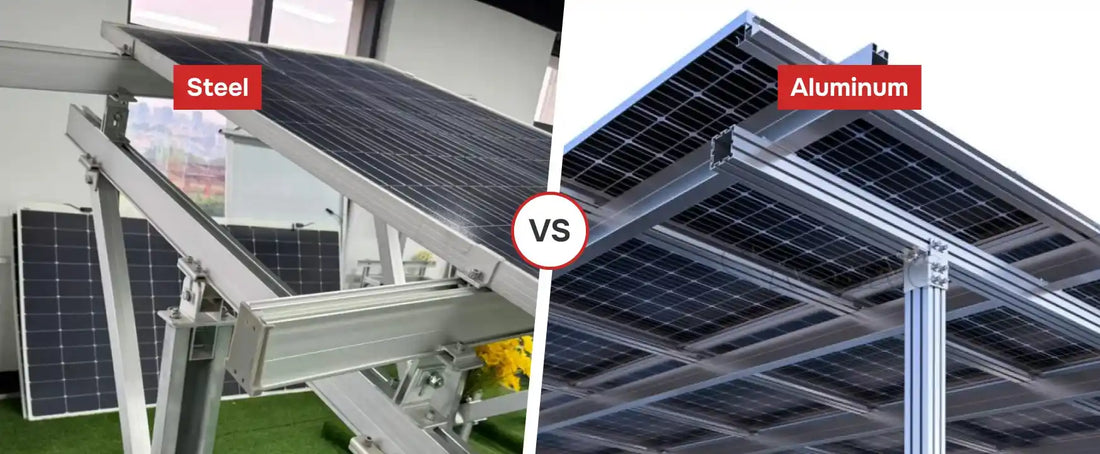
Mounting racks have to hold a solar array steady for 25 years or more. Nearly every U.S. system uses galvanized steel or extruded aluminum, and the two behave very differently under wind, snow, salt air, and roof weight limits. Steel vs. Aluminum Solar Panel Racking comes down to a few clear distinctions.
Steel vs. Aluminum Solar Panel Racking at a Glance
Both metals appear across different types of racking systems, so here is how they compare on the factors that matter most.
Quick Comparison Table
| Factor | Steel | Aluminum |
|---|---|---|
| Weight | 7.85 g/cm³; nearly three times denser | 2.70 g/cm³; significantly lighter for rooftop systems |
| Stiffness & Load Capacity | High: Supports longer spans and heavier snow loads | Low: Deeper, ribbed profiles help resist bending |
| Corrosion Resistance | Low: Relies on its zinc coating | High: Self-repairing oxide layer |
| Installation | Heavier sections; field drilling, cutting, and coating touch-up may be required | Lightweight profiles with pre-slotted channels; easier handling and faster installation |
| Cost | Lower price per pound | Lower freight and labor cost |
| Maintenance | High: Coating inspections, field-cut touch-ups, and recoating | Minimal: Clamp torque, isolation hardware, and flashing seals inspections |
| Best Applications | Ground-mounted and utility-scale arrays, long spans, heavy snow loads | Rooftop arrays, retrofits, coastal sites, and weight-sensitive structures |
Now let’s look closely and analyze each factor.
Steel vs. Aluminum Solar Panel Racking: The Key Differences
Five factors explain nearly every performance gap between them.
Strength and Load Capacity
- Structural steel has an elastic modulus of about 29,000 ksi, making stiffness the biggest gap between the two materials. A steel rail bends less over the same span, supporting longer rails and handling heavier snow loads.
- At 10,000 ksi, 6000-series aluminum alloys close the gap through shape instead of mass. Manufacturers use deeper, ribbed profiles that resist bending without adding weight, which is why aluminum rails can still pass code in most snow regions.
Corrosion Resistance
- Steel has no natural defense, so it depends on zinc. Hot-dip galvanizing to ASTM A123 leaves a zinc layer roughly as thick as a sheet of paper. Drill or cut the steel on-site, and you expose bare metal, where rust starts.
- Aluminum forms its own oxide skin that reseals when scratched, preventing corrosion. Salt air can still damage it, so coastal jobs use anodized or powder-coated profiles. Aluminum also corrodes where it touches steel, so mixed joints need stainless hardware and isolating washers.
Weight and Installation
- Steel is three times as dense as aluminum at the same volume. Building codes count panels and racking as permanent roof loads, and older decks rarely have capacity to spare. Steel usually arrives plain, so crews drill it on-site and touch up each cut with cold-galvanizing.
- Aluminum is much lighter, with built-in slots for clamps and grounding hardware. That means smaller crews, no lifting equipment, and shorter days on the roof. For metal roofs, aluminum is preferred for the same reasons, regardless of rail-based or rail-less mounting.
Cost and Long-Term Value
- Steel costs less per pound and maintains its edge on large ground mounts, where a single crew can cover thousands of panels.
- Aluminum costs more as raw material but less to ship and install. On rooftop jobs, savings in labor and handling can offset much of the higher material cost.
Maintenance Requirements
- Steel needs more upkeep with coating inspected, cut or drilled sections touched up, and full recoating after a few decades in humid or coastal conditions.
- Aluminum needs far less maintenance with clamp torque, isolating washers, and flashing seals checked during routine inspections. Neither material is maintenance-free, but steel carries the longer task list.
Interesting Read:
Practical Solar Panel Maintenance Tips to Protect Your Investment
Matching those demands to your site is the next step.
Which Racking Material Fits Your Solar Project?
The answer follows from where the array is installed and the structural load on it.
Choose Steel If...
- The array is ground-mounted or utility-scale, where foundations absorb the weight.
- Heavy snow or high winds call for longer spans and fewer posts.
- The site is dry and inland, so the zinc coating outlasts the panels.
- The crew is equipped to handle heavy sections and coating touch-ups.
Choose Aluminum If...
- The array goes on a roof with little weight to spare.
- The site is coastal, humid, or chloride-heavy.
- The installation process has to move fast with a small crew.
- The project is a retrofit where added weight is a concern.
A few site details must be considered before the final decision.
Factors to Check Before You Decide Racking Material
Four considerations make the material choice much easier:
- Installation Environment
Salt spray, industrial fumes, and agricultural ammonia all shorten coating life. Anodized aluminum handles sea air well, and matching module frames and rails prevent mixed-metal joints at the clamp. Dry inland sites let galvanized steel run for decades.
- Structural Load Requirements
Wind lift is strongest at roof edges and corners, and snow drives rail-based mounting size across northern states. Also, Aluminum expands about twice as much as steel with heat, so long rails need expansion joints. Material deflection, not yield strength, usually sets the maximum span.
- Project Budget
Compare installed cost, not metal price. Add shipping, crew hours, hardware, and any recoating over the system's life. That total often flips what per-pound pricing suggested.
- Expected System Lifespan
Panels carry 25-30 year warranties, and racking should outlast them. Galvanized steel manages that inland, not so much on the coast. An aluminum solar mounting structure remains stable with minimal upkeep.
Conclusion
There is no single winner in the Steel vs. Aluminum Solar Panel Racking debate.
Steel works best where foundations carry the load and longer spans or heavy snow demand greater stiffness. Aluminum is better suited to rooftops, coastal sites, and projects where lower weight and faster installation matter.
The right choice depends on your structure, climate, and total installed cost.