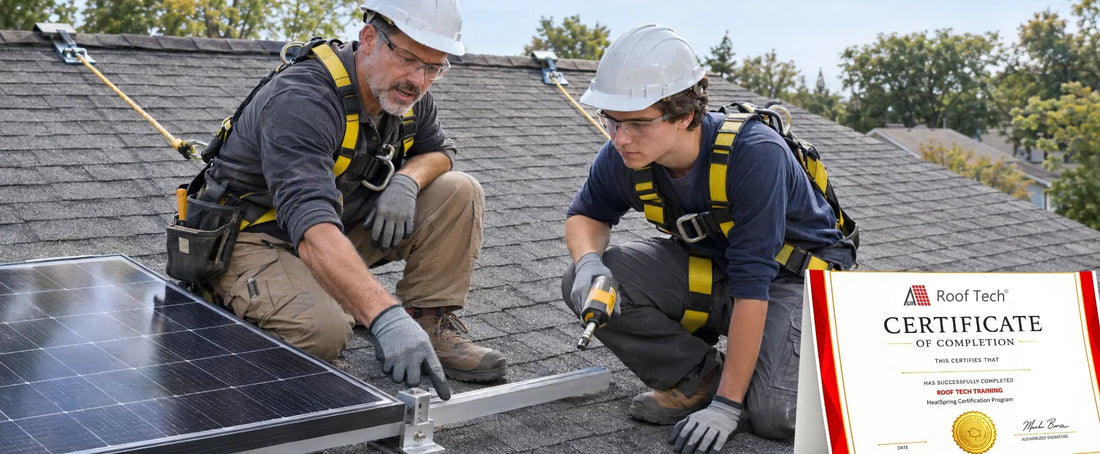
To become a certified solar installer in the U.S., you need training, field hours, and a passed exam, usually from the North American Board of Certified Energy Practitioners (NABCEP). Most states don't require solar certification, but electrical work needs a state or local license.
Here is how to become a solar installer and get certified.
What Does a Certified Solar Installer Do?
A certified solar installer builds and maintains solar power systems. The job covers fixing roof mounts, setting panels, wiring them to an inverter, and testing the system before inspection.
- Solar Installer vs. Solar PV Installer
The two titles are often used for the same job. A solar installer mounts solar equipment on roofs or the ground.
A solar PV installer works on photovoltaic systems that produce electricity and also handles wiring, inverter connections, and electrical code regulations.
- Daily Tasks on a Residential Solar Job Crew
- The crew checks the roof against the approved plan set.
- Attachments go into the rafters, and each hole/penetration is sealed.
- Racking, panels, and inverter wiring are connected next.
- Polarity, grounding, and output are tested before inspection.
- Baseline Abilities for New Installers
- Working safely on ladders and roofs.
- Lifting and carrying heavy panels and racking.
- Understanding basic electrical concepts like voltage, current, and circuits.
- Using basic algebra and geometry to work out tilt angles, spacing, and measurements.
The six steps below build on these basics.
How to Become a Certified Solar Installer in Six Steps
Most installers certify after working on real projects.
- Meet the Basic Education and Experience Requirements: Most solar employers ask for a high school diploma or GED and a valid driver's license for travel between job sites.
- Learn Solar PV System Fundamentals: Your first lessons should help you learn how solar panels work and why each panel added to a series string raises its voltage.
- Complete Solar Installer Training: Training hours from a solar installer course with a NABCEP Registered Training Provider are accepted for NABCEP credentials.
- Gain Hands-On Installation Experience: Your field hours will mostly come from an entry-level crew job or an apprenticeship. Solar apprentices are listed as Construction Craft Laborers.
- Choose a Recognized Solar Certification: Your current role decides the credential. New installers usually take the NABCEP PV Associate (PVA) exam, while design-level installers pursue the PV Installation Professional (PVIP).
- Meet Local Licensing and Electrical Requirements: Your state licensing board and local authority having jurisdiction (AHJ) can confirm which license you need.
- Check your state and city rules.
- Study Ohm's law and PV basics.
- Enroll with a registered training provider.
- Log hours on supervised installs.
- Match a credential to your role.
- Book and pass the exam.
- Apply for your state license if needed.
- Send applications for trainee roles.
- Keep adding field experience.
- Renew credentials on time.
Key Skills Covered in Solar Installation Training
Good solar installation training covers six topics.
- Solar PV Design and System Components: You learn to size a system from a home's energy use and match modules to the inverter.
- Electrical Wiring and Safety: NEC Article 690 is the part of the electrical code written for PV systems. It includes the rapid shutdown rule, which drops voltage on rooftop wiring fast enough to protect firefighters.
- Roof and Mounting-System Installation: Students learn the different types of racking systems and when a rail-based or rail-less mount suits a roof, based on its age and wind exposure. They also practice sealing roof penetrations to keep out rain. Some mounts, like the RT-MINI II self-flashing base, come with a built-in waterproof seal.
- Inverters, Batteries, and Other Solar Equipment: Courses explain how power flows from the panels through the inverter to the home or a battery.
- System Commissioning and Maintenance: After the install, commissioning tests confirm the wiring and output. Routine solar panel maintenance is covered too.
- OSHA and Job-Site Safety Training: Most new installers take OSHA 10-Hour Construction training. OSHA requires fall protection when a worker could fall 6 feet or more.
State rules then decide whether you can legally work alone.
Is a Certification Required to Install Solar Panels?
Most states do not, because a license grants the right to work while a certification shows knowledge.
- Solar Installer Certification vs. Solar Installer License: NABCEP solar certification is voluntary, while a solar installer license is a state or city permit for defined work.
- When Electrical or Contractor Licensing Applies: Wiring and grid connection usually need a licensed electrician, and some states issue solar contractor licenses.
- Why Solar Installer Requirements Differ by State: Local AHJs add permit conditions to state rules, and some states pay solar subsidies only when certified installers do the work. IREC's solar licensing database lists the rules by state.
- Can You Install Solar Without Professional Certification? Most states allow it if you hold the required license. Many lenders still ask for NABCEP-certified crews.
The table below compares the main credentials.
Solar PV Certification Options Compared
Most installers choose from these four.
| Certification | Best Fit | What It Takes |
|---|---|---|
| NABCEP PV Associate (PVA) | New entrants and career changers | A registered course or PV work, plus the exam |
| NABCEP PV Installation Professional (PVIP) | Experienced installers and crew leads | OSHA 10, advanced training, project credits, and the exam |
| Entry-Level Solar Certificates | Beginners learning PV basics | A course ending in a completion certificate |
| Manufacturer-Specific Training | Installers using one brand's equipment | Product setup and warranty courses |
Solar Installer Certification Requirements
Check these solar installer qualifications before you apply to become a certified solar installer.
- Education and Technical Knowledge
- No college degree is needed.
- PVIP needs 58 hours of advanced PV training, with at least 40 accredited.
- Work Experience and Hands-On Training
- The PVA experience pathway asks for six months of full-time PV work.
- PVIP needs six project credits in a decision-making role.
- Safety and Electrical Training
PVIP applicants need 10 hours of OSHA construction training.
- Certification Exam Requirements
PVIP exams follow application approval; PVA students book through their provider.
- Continuing Education and Credential Maintenance
- Board certifications renew every three years with 30 CE hours and proof of industry work.
- PVA holders need 12 CE hours per cycle.
Meeting these rules costs more than the exam fee.
How Much Does Solar Installer Certification Cost?
Training and NABCEP fees make up most of the bill.
- Training and Course Fees
A 40-hour online installer course costs about $1,295, and solar installer certification online packages with exam prep cost more.
- Certification and Exam Costs
- PVIP application and exam: $500 total
- PVIP retake: $275
- PVA exam: $125
- Tools, Safety Equipment, and Other Expenses
Installers usually buy their own boots, gloves, and multimeter, but employers provide fall protection.
- Employer-Sponsored Solar Training Options
Many employers pay trainees' exam fees, and apprenticeships pay wages during training.
After certification, practical skills decide how you perform on site.
Skills Every Certified Solar Installer Needs
Employers check these skills before hiring or promoting installers.
- Sizing conductors and testing polarity and grounding with a multimeter.
- Finding rafters, measuring accurately, and sealing roof penetrations.
- Reading the single-line diagram, which shows current flow.
- Tracing a fault to one string or connector before replacing parts.
- Keeping homeowners updated on inspections.
- Using fall protection and lockout/tagout every time.
These skills also decide how fast you move up the career ladder.
Certified Solar Installer Career Path Explained
U.S. employers had 31,100 solar PV installers in 2025, and most move through these stages.
| Career Stage | Typical Focus | Common Credential |
|---|---|---|
| Entry-Level Trainee | Safety, tools, basic PV installation | OSHA 10 |
| Solar Installer | Installation and system assembly | NABCEP PVA |
| Certified Installer | Advanced technical responsibilities | NABCEP PVIS |
| Lead Installer | Crew supervision and quality control | NABCEP PVIP |
| Solar PV Professional | Design, commissioning, or specialized work | PVIP or PV Design Specialist |
| Solar Contractor/Business Owner | Running projects and the business | Contractor or electrical license |
Final Thoughts on Starting Your Solar Installer Career
Most installers start with OSHA 10 and a registered course. After that, supervised installation work gives you the field hours that employers and NABCEP require.
Check your state's licensing rules before doing any wiring, and keep a log of every project with the system size and your role. NABCEP asks for those records at the PVIP stage, and they also help when you apply for lead or design-level solar installer jobs.