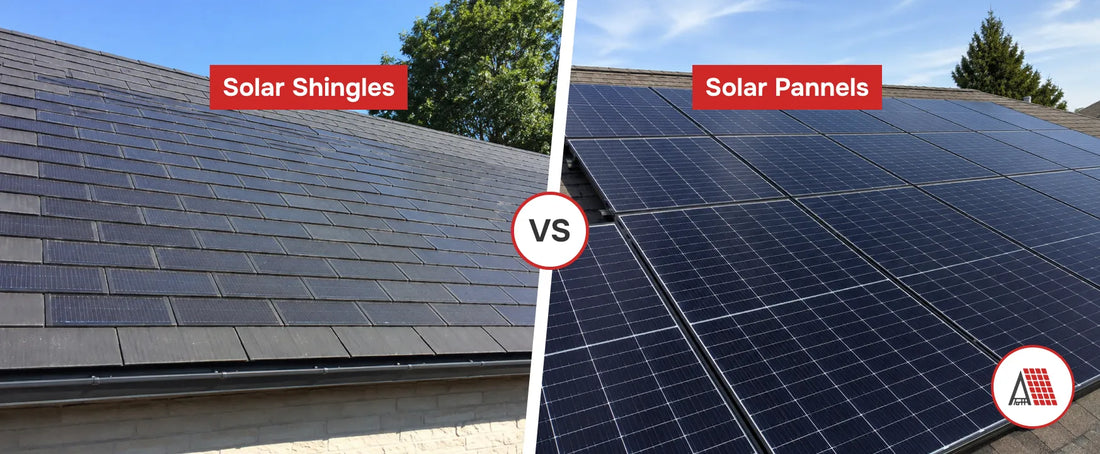
In addition to protecting your home from environmental forces, your roof can also generate power. However, the solar solution you select is more important than many U.S. homeowners realize.
Between solar panels vs solar shingles, the former has been the go-to option for decades, and the latter is the newer, more roof-integrated alternative. Both generate electricity from sunlight, but there are key differences to consider.
In this guide, we will compare and analyze every factor that truly matters: cost, efficiency, installation, aesthetic appeal, and durability, so that you can make the right decisions for your home.
Solar Panels vs Solar Shingles: Side-by-Side at a Glance
Before diving into the details, here's a quick comparison overview of these two technologies.
| Factor | Solar Panels | Solar Shingles |
|---|---|---|
| Efficiency | 20–22% | 14–20% |
| Cost (avg) | $15,000–$25,000 | $27,000–$100,000+ |
| Lifespan | 25–30 years | 25–30 years |
| Installation | Mounted on existing roof | Replaces existing roof |
| Aesthetics | Visible on roofline | Flush, seamless appearance |
| Best For | Maximum output, lower cost | Integrated design, curb appeal |
| Availability | Widely available | Limited availability |
| Warranty | 25-year product & performance warranty | Varies by manufacturer |
Now let's get into the specifics.
Solar Shingles: Seamlessly Integrated Into the Roof
Solar shingles, also called photovoltaic shingles or solar roof tiles, are roofing materials engineered to do two things at once: shield your home from the elements and generate electricity. Unlike conventional panels, they are not installed on top of your roof; they are the roof itself.
This category falls under Building-Integrated Photovoltaics (BIPV), a concept that integrates active solar technology into building materials. Manufacturers like Tesla (Powerwall Solar Roof), GAF Energy (Timberline Solar), and CertainTeed (Apollo) are among the key players in the US market.
Some shingle designs offer a completely seamless appearance with concealed solar cells; others have a slightly visible cell pattern. Either way, the goal is to generate solar power without compromising aesthetics.
The Science Behind Solar Shingles
Solar shingles use the same fundamental photovoltaic technology as traditional panels. Thin-film or monocrystalline silicon cells within each shingle capture sunlight and convert it into direct current (DC) electricity. That DC power then travels to an inverter, where it gets converted to alternating current (AC) for home use.
They're compatible with both grid-tied systems and off-grid setups. Add a battery such as the Tesla Powerwall, Enphase IQ Battery, Franklin Home Power, or Generac PWRcell, and you've got backup power storage integrated into the same system.
The primary difference between solar panels vs solar shingles isn't the technology; it's the other factors, which we'll cover shortly.
Solar Shingles: Honest Pros and Cons
Pros:
- Blends into the roofline with no visible racking or mounted hardware
- Fulfills a dual purpose, replacing roofing material and generating power
- Strong wind and hail resistance (some rated for Class 3 or Class 4 impact)
- May increase home resale value due to curb appeal
- Eligible for federal Investment Tax Credit (ITC)
Cons:
- Significantly higher initial cost, averaging $27,360 to $100,000+
- Lower efficiency (14–20%) compared to traditional panels
- Limited available installers due to specialized labor requirements
- Harder to repair or replace individual shingles
- Fewer brand options in the market
Now that we understand solar shingles, let’s move on to what most U.S. homeowners are already familiar with: solar panels.
Trying to decide between installing traditional solar panels or investing in solar roof tiles during a roof replacement? Read this Reddit discussion where homeowners compare costs, aesthetics, energy production, and long-term value: New roof and panels vs. solar roof tiles
Traditional Solar Panels: Proven Performance, Practical Value
Solar panels are photovoltaic arrays of modules installed on your roof using various mounting systems, including aluminum racking and rail-less systems. They’re the most dominant form of residential and commercial solar installations in the United States.
Modern residential panels are predominantly monocrystalline silicon, which offers the highest efficiency in the standard panel category. Top brands in the US market include SunPower, REC Group, Panasonic, and Q CELLS.
Unlike shingles, panels don't replace any roofing material; they're mounted on top of your existing roof.
How Solar Panels Convert Sunlight to Power
Each panel typically contains 60-72 photovoltaic cells, made from silicon wafers. When sunlight hits the silicon cells, it causes electrons to move, creating direct current (DC) electricity. Just like the shingles, the DC is converted to AC after it passes through an inverter, and then it is used throughout your home.
Depending on state and utility regulations, excess electricity may be credited through net metering or similar compensation programs, or stored in a battery system such as the Tesla Powerwall or Enphase IQ Battery.
Solar Panels: Honest Pros and Cons
Pros:
- Power efficiency of 20–22%, with premium models reaching 23%+
- Lower upfront cost, averaging around $15,000–$25,000
- Widely available; thousands of certified installers nationwide
- Easier to manage, repair, replace, and expand the system
- Product and performance warranties of 25–30 years
- Faster ROI with typically 6–12 years depending on location and usage
Cons:
- Visually prominent, visible above the roofline
- Mounting hardware penetrates the roof structure
- Less suitable for complex roof designs or limited sun exposure
- Requires a complete roof evaluation before installation
While traditional solar panels deliver reliable performance and strong financial returns, understanding how they compare to building-integrated photovoltaic (BIPV) shingles is crucial before making a final decision.
Recommended Read:
Solar Panel Maintenance Tips: What to Do and When to Call a Pro
For a quick and easy decision, here’s a consideration flowchart:
Solar Panels vs Solar Shingles: Breaking Down Every Factor
I. Cost
Solar panels: The average US homeowner pays $15,000 to $25,000 for a standard residential system, and that's before the federal Investment Tax Credit (ITC) reduces the cost by 30%. In many states, additional incentives, such as net metering credits, state rebates, and SREC programs, further reduce overall investment.
Solar shingles: Entry-level Solar shingle roof installations start around $27,000 and can exceed $100,000 for larger homes or complex rooflines. The higher price reflects both the material technology and the full scope of the roof replacement.
Bottom line: Panels are considerably more cost-effective for most homeowners. Shingle-only approaches are competitive only when a full roof replacement is already needed.
II. Installation
Solar Panels: Installing solar panels on your existing roof is straightforward. A certified installer mounts a racking system, secures the panels, and connects them to the home's electrical system. Each panel can also be mounted separately in a rail-less solar system. Physical installation is often completed within one to three days, though permitting and utility approvals can extend the overall timeline.
Recommended Read:
Solar Panel Installation Process | Step-By-Step Guide
Solar Shingles: Installing solar shingles is a full roof replacement project. Your existing roof is replaced with a combination of solar-active and standard roofing shingles. The process demands both roofing and electrical expertise, making installation more complex and labor-intensive.
Bottom line: Solar panels are faster, simpler, and less expensive to install. Once again, solar shingles become viable only when you're already replacing a roof or building a new home.
III. Efficiency
Solar Panels: Standard solar panels typically offer 20-22% power-generation efficiency. High-end monocrystalline panels from SunPower or REC can exceed 23%. Realistically, a 2,000 sq ft panel array produces more usable electricity than the same area covered with shingles.
Solar Shingles: This approach falls in the 14–20% efficiency range. The design constraints of thinner PV cells and fixed angles limit their output compared to mounted panels.
Bottom line: If maximizing electricity generation is your priority, panels are the better choice.
IV. Aesthetics
Solar Panels: Traditional solar panels are fixed above the roof on mounting hardware, making them clearly visible and identifiable. Most homeowners are already used to this look, but it’s undeniably bulkier than shingles.
Solar Shingles: This approach is preferred when aesthetics is the primary consideration, as it offers the sleekest appearance. Viewing from street level, they sit flush with the roofline and look nearly identical to standard asphalt or slate shingles.
Bottom line: Solar shingles are the clear winner when visual appeal and roof integration are top priorities.
V. Durability and Lifespan
Solar Panels: They are rated to handle significant wind, hail, and snow loads, with a 25-30-year lifespan under normal conditions. Most solar panels carry UL 61730 certification and enable relatively easy maintenance since each module can be repaired or replaced separately.
Solar Shingles: They can also survive for approximately 25–30 years. Products such as the Tesla Solar Roof are rated for Class F wind resistance and Class 3 hail impact, often exceeding the durability of conventional roofing materials. However, repairing or replacing damaged shingles can be more complex and may require a certified installer.
Bottom line: Both options offer similar longevity and durability, but solar panels are generally easier and less expensive to maintain over time.
VI. Home Value and Resale
Solar Panels: A study found that homes with solar panels sold for about 4% more than non-solar homes. This indicates that homeowners prefer buying a house with pre-installed solar panels.
Solar Shingles: Solar shingles may increase resale value due to their integrated appearance and curb appeal, particularly in higher-end housing markets. However, because the technology is relatively new and less common, buyer awareness and trust remain lower than that of traditional panels.
Bottom line: Both systems can enhance property value, but panels have a longer track record, while shingles require some time for consumer behavior to change.
VII. Availability
Solar Panels: They are already widely adopted across the United States. Most cities and suburbs have multiple certified installers and manufacturers, creating strong competition and pricing flexibility.
Solar Shingles: There’s a much smaller network of manufacturers and certified installers for solar shingles. For instance, Tesla installs through its own channels, while GAF Energy works with approved roofing contractors, which makes pricing less competitive.
Bottom line: Solar panels are far easier to source, install, and service due to their widespread availability and established installer network.
VIII. Commercial Application
Solar Panels: For commercial properties, traditional solar panels are the first choice due to their higher efficiency, easier availability, and ability to scale across large roof areas. They are widely used in warehouses, offices, retail centers, and industrial facilities to maximize energy savings and ROI.
Solar Shingles: Building-integrated solar systems are typically reserved for commercial projects where architectural aesthetics are a priority. Hotels, corporate headquarters, and premium developments may choose shingles to maintain a visually pleasing appearance while incorporating renewable energy generation.
Bottom Line: Solar panels deliver greater energy output, better economics, and a stronger return, while solar shingles are best suited for design-focused projects where appearance outweighs cost considerations.
Solar Panels vs Solar Shingles: Which One Makes Sense for You?
When deciding between solar panels vs solar shingles, the final choice depends on your priorities and circumstances. In most cases, solar panels are the better investment, generating more power per area and delivering quicker return on investment.
Got 10 or more years of lifespan left before your roof needs replacement? Then, panels are the way to go, no questions asked. But solar shingles make sense in the following scenarios:
- Your roof needs replacement; combining roof and solar into one project reduces the cost gap
- You're building a new home and want solar integrated from day one
- HOA restrictions or neighborhood aesthetics prohibit traditional panels
- Visual appeal is a high priority, and you're willing to pay extra for it
Before making a decision, evaluate your roof's condition, local/government incentives, your home’s energy needs, and overall project budget. By carefully weighing both technologies, you can choose a solar solution that delivers the best balance of performance, aesthetics, and value for years to come.