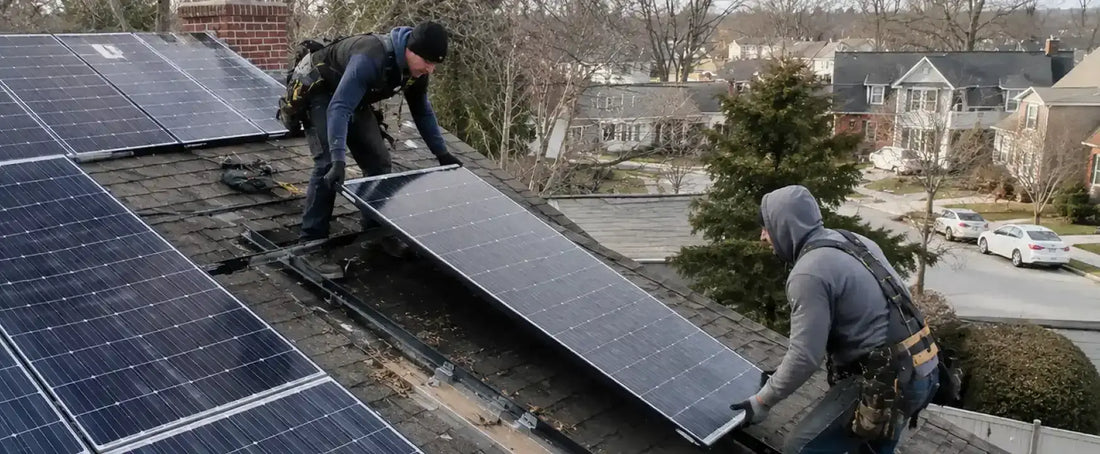
Solar panels generate power for 25 to 30 years, but an asphalt shingle roof rarely lasts that long. Most solar homeowners eventually face a worn-out roof under an array that still works perfectly. The practical question then is: how do you replace a roof with solar panels already mounted on it?
Can a Roof Be Replaced While the Solar Panels Stay in Place?
That depends on how much of the roof needs maintenance. Roofers are also not licensed for electrical work, so homeowners often ask, “How do you remove solar panels to replace roof sections?” The answer typically involves two separate crews: a solar crew and a roofing crew.
- A full tear-off cannot be done with the panels attached, since roofers need clear access to the decking.
- Smaller repairs work differently, because damage away from the array can be fixed without touching the panels.
- Damage beneath the panels still calls for temporary removal.
Once removal is confirmed, how do you replace a roof with solar panels becomes a sequencing question.
How Do You Replace a Roof With Solar Panels? The Five-Stage Process
To answer “how do you replace a roof that has solar panels?” we need to discuss the sequence of work:
-
Inspect the Roof and Solar System
A roofing contractor assesses the shingles, decking, and flashing, while your solar provider checks the mounts, rails, wiring, and inverter. A pre-installation roof inspection records the roof's condition in writing. Record the system's output first, so you have a benchmark for reinstallation.
-
Disconnect and Store the Panels
A licensed solar crew shuts down the system, then removes the panels, rails, and mounting feet in that order. Every connector and mount position is photographed so the array goes back in the same layout.
-
Tear Off and Rebuild the Deck
Rotted sheathing should be replaced before installing the new underlayment, flashing, and roofing. Ask the roofer to mark the original mounting penetrations, since those points line up with rafters and can often be reused.
-
Reinstall the Mounting System
Hardware must be installed before the panels, as proper mounting keeps the new roof watertight. Each attachment must connect to a rafter, seal at the deck, and fit properly with the shingles. Your existing or new type of solar racking system must suit the new surface.
-
Reconnect and Confirm Production
Rails, panels, and wiring are reinstalled in that order. Bolts are torqued to specification, since over-tightening cracks panel frames, and under-tightening lets the array shift in wind. If performance drops from pre-removal levels, a loose connection is usually the cause, not a failed panel.
The sequence answers half of the question “how do you replace a roof with solar panels?” And cost answers the rest.
What Does a Roof Replacement With Solar Panels Cost?
Five factors usually affect the final price.
- Panel removal and reinstallation: The detach-and-reattach process typically costs $1,500 to $6,000, or roughly $200 to $500 per panel.
- Roof pitch, size, and material: A larger, steeper, or harder-to-access roof costs more to replace. Metal roofing costs more upfront but can last 40 to 70 years.
- Roof repairs: Damaged decking, flashing, or other roof components add to the total cost.
- Mounting hardware: Some flashing, sealants, mounts, or other components may need to be replaced during reinstallation.
- Permits and inspections: Local permit and inspection fees may apply, depending on the work and local rules.
Mounting hardware is what homeowners know least about.
What Happens to the Solar Mounting System During a Roof Replacement?
The racking passes through three stages that affect how the roof sheds water.
-
Removing the Existing Mounts
Each mounting foot is unbolted, and every penetration is photographed before the old roofing is stripped. Those positions record where the rafters sit.
-
Reusing Rails and Clamps
Rails and clamps in good condition are usually reused, though rail-based and rail-less systems differ in what you can reuse. Base flashing and sealants should always be replaced.
-
Fitting Hardware to a New Roof Surface
Changing the roofing material means changing the attachment method. Tile, standing-seam metal, and shingle each need their own mounting design.
This is simpler for homeowners who have not gone solar yet.
When Should Roof Replacement Come Before Solar Installation?
Replace the roof first if it has only five to ten years of life left. Installing a 25-year solar system on an aging roof may force you to remove and reinstall the panels in 5-10 years, adding extra labor and cost. If you are already wondering, “How do you replace a roof with solar panels?” it is usually better to reroof before the solar system is installed.
A few checks protect the work before panels return.
What to Check Before the Panels are Reinstalled?
Confirm these four points in writing beforehand.
- Roof Compatibility: Confirm the new roofing material can carry the weight and layout of your array. Shingle, tile, and metal accept different attachment methods.
- Mounting System Match: Hardware rated for the previous roof may not suit the new one. Check the wind and snow load ratings for your area.
- Warranty Coverage: Two warranties apply, one from the roofing manufacturer and one from the solar equipment provider. Unapproved work can void either warranty.
- Professional Installation: This work involves live DC circuits and structural attachment points. Use a certified PV professional and a roofer experienced with solar system projects.
Conclusion: Treat the Roof and Solar Array as One Project
A roof replacement and a solar reinstallation form a single project executed by two separate trades, and homeowners who book them separately end up paying for the waiting time and confusion in between.
The outcome depends largely on how well the existing system is documented and how precisely the mounting positions are recorded before the panels are removed.
Coordinating both contractors under one schedule keeps the remaining work in sequence.