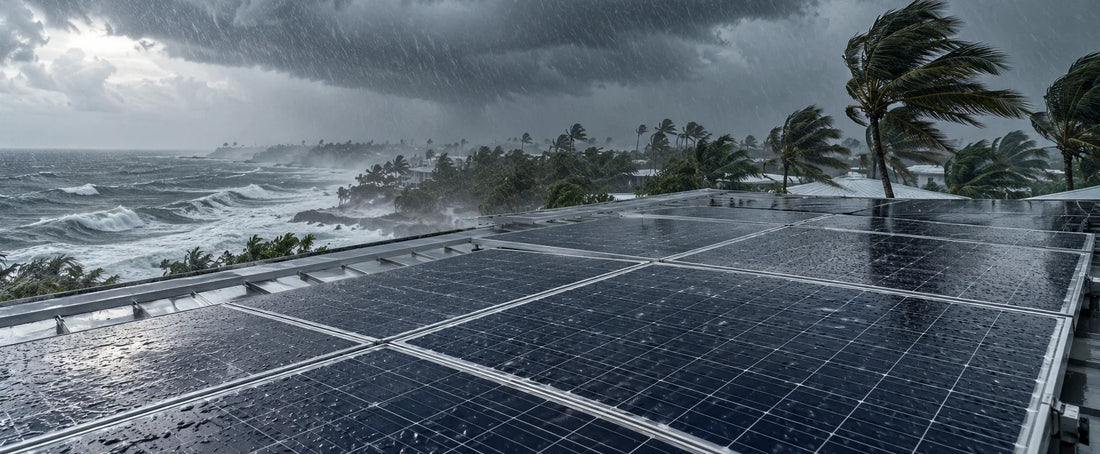
For homeowners in the USA and Canada with solar panels, hurricane season raises the question of whether their rooftop system will survive. Manufacturers test panels and mounts against strong winds and heavy rain, and field reports support those tests. Installers who checked New Jersey rooftops after Superstorm Sandy in 2012 found little or no damage on most systems.
Most damage comes from flying debris or weak mounts. For many homeowners with solar panels, hurricane outages are the larger problem, since serious physical damage is rare.
This guide explains how wind ratings work and how to prepare a system before landfall.
How Do Solar Panels Hold Up in Hurricanes, and What Are Wind Ratings?
So, can solar panels survive a hurricane? Properly installed solar panels can withstand a hurricane, but the rating printed on a panel describes only the module itself.
Panel Wind-Load Ratings
A panel's wind rating comes from a lab test. Most panels pass at a load of 2,400 pascals, about 50 pounds per square foot. That is close to the pressure of a 140 mph wind, which falls in the 130 to 156 mph range of a Category 4 hurricane.
No manufacturer sells fully hurricane-proof solar panels. RMI's Solar Under Storm research, based on Caribbean fieldwork, found that rooftop arrays can be made storm-resilient at little extra cost.
The Panel vs. the Full Mounting System
Wind moves faster over the top of an array than under it. The pressure above the panels drops, and the panels are pulled upward. This upward pull is called uplift.
The clamps, rails, and screws carry this load down into the roof rafters. If one of them fails, the array can lift off the roof even when the panels have no damage.
Roof Tech's RT-MINI II mount is rated for winds up to 180 mph and approved for Florida's High-Velocity Hurricane Zone. Mounts rated at that level help keep solar panels hurricane-resistant on exposed coastal homes.
Installation Quality
In hurricane zones, installers fasten mounts into the rafters and leave a gap at roof edges and corners, where wind suction is highest. An aging roof should be replaced before the panels are installed.
After Hurricane Ian, one Florida installer found that arrays on RT-MINI II mounts stayed in place through the storm, and the roof sections under them stayed leak-free.
A well-built array still faces several storm hazards.
How Do Each Hurricane Hazard Affect a Rooftop Solar System?
On rooftop solar panels, hurricane forces act on different parts of the system at different stages of the storm.
- High Winds: Hours of repeated gusts can slowly loosen clamps and bolts. Each gust lifts the array slightly and lets it settle back. Over a long storm, the strain builds up at the attachment points.
- Flying Debris: Debris is the most common cause of panel damage, since a falling branch can crack the tempered glass and let moisture reach the cells.
- Heavy Rain: Panels are sealed against rain. The weak spots are the roof penetrations, where wind-driven water can get past poor flashing. The RT-PLUS mount uses a self-flashing AlphaSeal base that keeps these attachment points waterproof on Gulf Coast roofs.
- Floodwater: Rooftop panels usually stay above floodwater. Inverters and batteries mounted on garage walls or near the ground are more exposed. In an NREL study of commercial and utility-scale systems, flooding and rain caused more weather-related outages than wind, with a median outage of two to four days.
- Racking and Electrical Damage: Bent rails and loose wiring are harder to spot than cracked glass. A wet junction box can also start a fire when the power comes back.
Wondering how solar panels performed during a major storm? Check out this Reddit discussion from r/houston, where homeowners share their experiences with solar power during severe weather and discuss how their systems performed: People with solar, how did you do during the storm? (r/houston)
A few checks before hurricane season prevent most of this damage.
How to Protect Solar Panels from Hurricanes?
A short routine each season keeps solar panels hurricane-ready.
- Have a technician check the mounts and roof flashing before June 1, as part of your routine solar panel maintenance.
- Clear loose items from the roof and the yard. Strong wind can lift patio furniture or loose roofing material and throw it into the array.
- Trim dead branches that hang over the array early in the season, since a falling branch can crack panel glass.
- Follow the manufacturer's storm guidance. Some ask owners to switch the system off before landfall.
- Charge the home battery to 100% and turn on storm mode if it has one.
- Photograph the panels and roof, and confirm the system is listed on your homeowners policy.
The next concern is power during the outage.
Do Solar Panels Work During Hurricanes?
Solar power during a hurricane is limited by cloud cover and by how the system is wired.
- Grid-Tied Solar: Most home systems are grid-tied and have no battery. When the grid goes down, the inverter turns the system off. This safety rule, called anti-islanding, protects utility crews working on downed lines.
- Solar With Battery Backup: Adding a battery changes this. The home can disconnect from the grid and keep using its own solar power. In a Florida Solar Energy Center case study, a home with a 6 kW array and 27 kWh of storage ran on its own power for five days during Hurricane Dorian.
Size the hurricane battery for the essential loads, for example, the refrigerator and some lights. Cloud cover after a storm can also slow recharging. Our guide to solar vs gas generators for backup power compares the two options.
Why Panels Alone Do Not Provide Backup Power
A solar array needs an inverter to convert the electricity into usable power, and a standard grid-tied inverter needs a working grid to run.
When the grid fails, power shuts off, even in full sun. Panels also stop producing at night.
A battery stores daytime power, and a backup-capable inverter separates the home from the grid to keep it running.
If the storm damages the system, the order of the next steps matters for safety.
What to Do After a Hurricane Damages Your Solar Panels?
Most systems need no repairs. If yours was damaged, follow these steps.
- Treat a broken panel or wet inverter as live, since panels produce electricity in daylight even with the grid off.
- Check the monitoring app for a sudden drop in output, which can mean a cracked panel or loose wire.
- Take date-stamped photos from the ground. Insurers compare them with the ones you took before the storm.
- Call your installer to check the wiring and roof penetrations and restart the system after repairs.
A one-page checklist makes these steps easier to follow under pressure.
Hurricane Solar Panel Safety Checklist
Keep this storm prep list with your system documents.
| Before the Hurricane | During the Hurricane | After the Hurricane |
|---|---|---|
|
|
|
Final Thoughts on Solar Array in Hurricane Zones
No installer can make solar panels hurricane-proof. Local wind codes, however, specify the wind speed each mount must withstand, and arrays that meet them perform well in storms.
Most damage comes from debris and weak mounts, and a yearly check before the season lowers that risk.
For homeowners with solar panels, hurricane season is also about continuous power supply, and a backup battery keeps the array running when the grid is down.