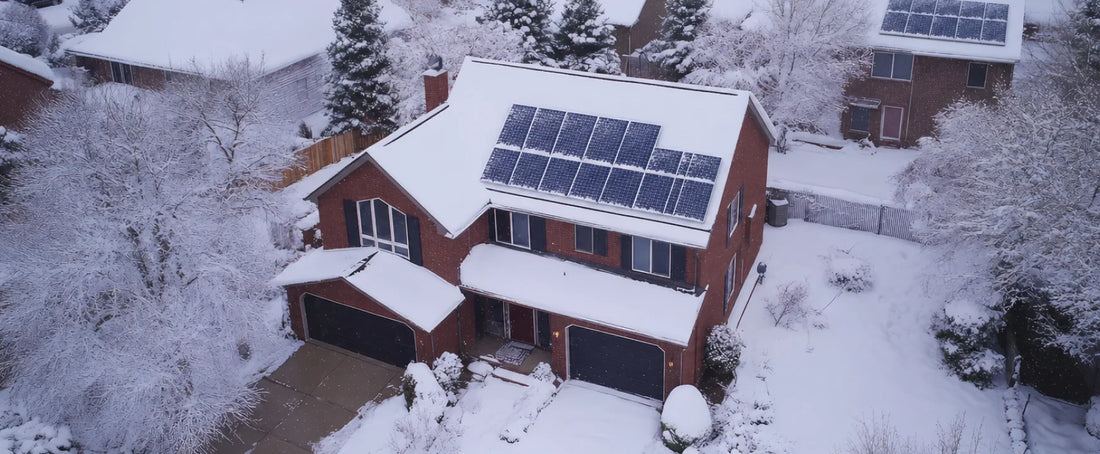
Solar panels continue to generate electricity through a Canadian winter, although their output is lower than in summer. Days are short, and the sun stays low in the sky. After a storm, snow can also cover the panels for a day or two. Low temperatures help, because solar cells convert sunlight more efficiently in the cold.
How solar panels in Canadian winter perform depends mostly on local cloud cover and on how quickly the array sheds snow.
Do Solar Panels Work in the Canadian Winter?
Yes. Solar cells generate electricity from sunlight, and winter skies still provide enough sunlight on most days.
- Why Cold Weather Raises Solar Panel Efficiency
Panels are rated at a cell temperature of 25°C (77°F). A silicon panel loses about 0.4% to 0.5% of its power for each degree above 77°F, and it gains a similar amount for each degree below it.
Solar panel efficiency is higher in cold weather, which means more power for each hour of sunlight. Total daily output is still lower because winter days are short.
- What Lowers Solar Panel Output in Winter
- Shorter days reduce the number of power-generating hours.
- The low winter sun strikes panels at a shallow angle and passes through more atmosphere.
- Some regions have cloud cover for weeks at a time.
- Snow blocks sunlight until it melts or slides off.
- How Snow Affects Solar Panel Production
Light snow usually slides off within one or two days, as the dark glass absorbs sunlight and warms up. A panel fully covered in snow produces no power. Partial cover can affect more than one panel, because panels on the same array share a single electrical current.
A field study found that snow on the ground reflects extra sunlight onto clear panels, with the largest gains on steeply tilted arrays.
- How Solar Panels Perform on Cloudy Winter Days
Solar panels can produce power under cloud cover because they also use the scattered sunlight that passes through clouds. Thin, high clouds let most light through, while thick, low clouds block much of it. Over an entire winter, cloud cover reduces output for solar panels in Canadian winters more than cold temperatures do.
Wondering whether solar panels are effective in Canada's climate? Check out this Reddit discussion from r/solar, where users share their experiences and insights about generating solar energy in Canada: For those who are still wondering if solar works in Canada
How Much Power Do Solar Panels Produce in a Canadian Winter?
Solar panel output in winter varies widely across Canada:
| Region | Winter Conditions | Yearly Output per kW Installed |
|---|---|---|
| British Columbia | Long cloudy periods on the coast | 1,009 kWh in Vancouver |
| Ontario | Overcast skies and lake-effect snow | 1,161 kWh in Toronto |
| Alberta and Saskatchewan | Cold, clear skies | 1,292 kWh in Calgary, 1,361 kWh in Regina |
| Quebec | Heavy snowfall that lasts for months | 1,185 kWh in Montréal |
| Atlantic Provinces | Wet snow and freezing rain | 1,074 kWh in Halifax |
| Northern Canada | Very few daylight hours in December | 960 kWh in Whitehorse |
What Determines Your Winter Solar Output
For an accurate figure, ask your installer for an estimate based on your exact address.
| Factor | Effect on Winter Output |
|---|---|
| System Size | A larger system generates more power in winter. |
| Roof Orientation | South-facing roofs receive the most winter sunlight. |
| Panel Tilt | Steeper panels shed snow faster. |
| Shading | Longer winter shadows reduce array output. |
| Snow Coverage | Fully covered panels produce no power. |
| Local Weather | Long overcast periods can lower output for weeks. |
| Daylight Hours | Northern locations get fewer daylight hours. |
| Solar Resource | Sunnier locations produce more power over a full year. |
Snow coverage is the only factor you can manage after installation.
Should You Clear Snow Off Your Solar Panels?
In most cases, no. Snow on solar panels melts or slides off without help, and the energy lost in the meantime is manageable.
- When to Leave Snow on the Panels
- Light snowfall.
- Your panels are steeply tilted.
- Snow expected to melt in the next thaw.
- Icy, slippery roofs that would need to be climbed.
- When Snow Removal Is Worth Considering
- Heavy snow that lasts through several sunny days.
- Your array is low-tilted.
- Ground-mounted arrays, which are reachable from the ground.
- Several days of near-zero output.
- How to Remove Snow Without Damaging Your Panels
- Stay on the ground. Do not climb onto an icy roof.
- Use a soft foam roof rake and pull snow down along the panel surface.
- Do not use shovels or ice scrapers, which can cause microcracks that may void the warranty.
- Hire a professional for two-story roofs or heavy snow loads.
A well-designed array reduces the need for snow removal.
Maximizing Efficiency of Solar Panels in Cold Weather and Snow
Most problems with solar panels in Canadian winter start with design choices made before installation.
- Choosing a Panel Tilt That Sheds Snow
Steeper panels shed snow faster. Michigan Tech researchers recorded yearly snow losses of 5% to 12% on raised test panels, with the steepest panels losing the least.
On a flush-mounted system, panels follow the roof angle. Knowing how to calculate your roof pitch helps you check that angle before requesting quotes.
- Planning for Heavy Snow Loads
Racking, the frame that holds the panels, must be rated for local snow and wind loads.
RT-APEX, a rail-less mount, is engineered for ground snow loads up to 90 PSF and wind speeds up to 180 mph.
Leave clearance below the lowest row for shed snow. Each roof attachment point also needs a reliable seal, because meltwater can refreeze into ice dams at the eaves.
- Planning for Winter Shading
A tree or chimney that doesn't shade the array in June can shade it at midday in December because the sun stays low. Ask your installer for a shade analysis based on the winter solstice.
After installation, a few simple checks during the season confirm that the system is performing as expected.
Solar Panel Maintenance in Winter: Safe Checks for Homeowners
For solar panels in Canadian winter, most maintenance involves checking the system from the ground and through the monitoring app.
- What to Monitor During Winter
- Daily output against the same month last year.
- Snow still on the panels days after a storm.
- New shading from snowbanks or trees.
- Inverter alerts or error codes.
- Cracked glass or shifted panels.
- Mistakes Homeowners Should Avoid
Avoid walking on panels or chipping ice off the glass. Both can crack the cells, even when the glass looks undamaged. Also, ladders should never be placed on icy ground.
Near-zero output during a snowy week is normal. However, zero output on a clear day with clean panels indicates a fault that needs an inspection.
With these checks in place, winter becomes a predictable period of lower output.
Final Verdict: Do Solar Panels Work in Canadian Winter?
Optimum performance of solar panels in Canadian winter starts with the design. Ask your installer for panels tilted to shed snow and for mounting solutions rated for local snow loads.
Once the system is running, let light snow clear by itself, and use a soft foam roof rake from the ground if heavy snow stays for several days.
Never walk on the panels or scrape the glass, and check the monitoring app regularly. That’s how you prepare your solar panels for Canadian winter.